
Relative clauses and pronouns
In summary
Relative clauses are types of subordinate clauses. They give extra information about
a noun/noun phrase and are often separated by commas.
Relative clauses
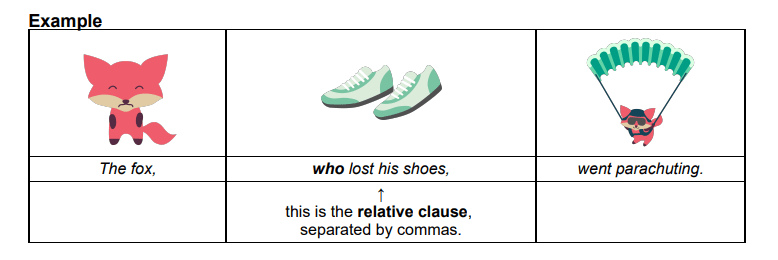
Relative clauses come straight after the noun they are giving more information
about a noun/noun phrase in a sentence. This is likely to be in the middle of the
sentence and might be separated by commas, as in the following example.
Relative pronouns
Relative pronouns are the words that introduce a relative clause. The relative
pronoun “who” is highlighted in bold above. Below is a full list of relative pronouns.
The one you’ll pick will depend on the type of person/object you’re describing.
who
for a person
which
people for an object
that
idea for an object (or person)
when
for a time
where
for a place

Remember that relative clauses might not always be embedded in the middle. They
can simply be tagged on the end (separated by a comma):

