

Quiz Summary
0 of 40 Questions completed
Questions:
Information
You have already completed the quiz before. Hence you can not start it again.
Quiz is loading…
You must sign in or sign up to start the quiz.
You must first complete the following:
Results
Results
0 of 40 Questions answered correctly
Your time:
Time has elapsed
You have reached 0 of 0 point(s), (0)
Earned Point(s): 0 of 0, (0)
0 Essay(s) Pending (Possible Point(s): 0)
| Average score |
|
| Your score |
|
Categories
- Not categorized 0%
- 1
- 2
- 3
- 4
- 5
- 6
- 7
- 8
- 9
- 10
- 11
- 12
- 13
- 14
- 15
- 16
- 17
- 18
- 19
- 20
- 21
- 22
- 23
- 24
- 25
- 26
- 27
- 28
- 29
- 30
- 31
- 32
- 33
- 34
- 35
- 36
- 37
- 38
- 39
- 40
- Current
- Review
- Answered
- Correct
- Incorrect
-
Question 1 of 40
1. Question
Stearic acid has a melting point of 69 °C.
A heated sample of pure stearic acid is cooled and the temperature is recorded every minute for
30 minutes. A graph of the results is shown.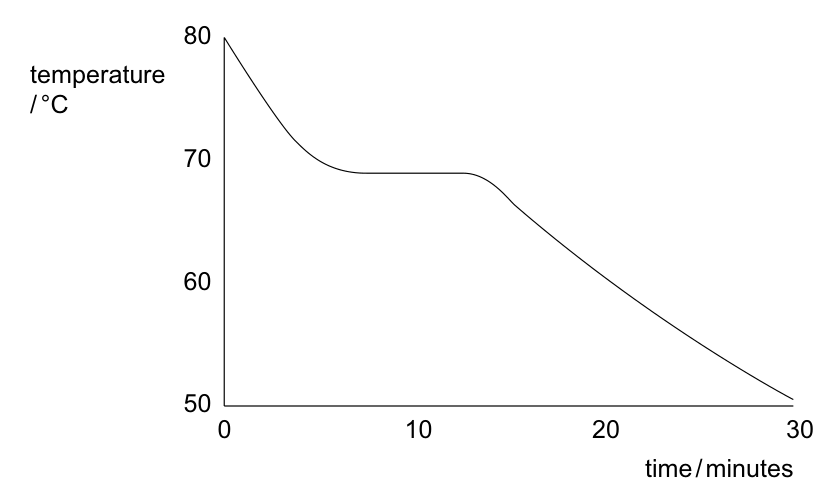
Which process occurs between 8 and 12 minutes?
CorrectIncorrect -
Question 2 of 40
2. Question
Which statements are correct?
1
The volume of a gas at constant pressure increases as the temperature increases.
2
When the pressure of a gas is increased the particles move closer together.
3
The pressure of a gas at constant volume decreases as the temperature increases.CorrectIncorrect -
Question 3 of 40
3. Question
Which substance would diffuse most quickly?
CorrectIncorrect -
Question 4 of 40
4. Question
Which diagram shows the arrangement of particles inside a balloon containing a mixture of the
gases nitrogen and oxygen?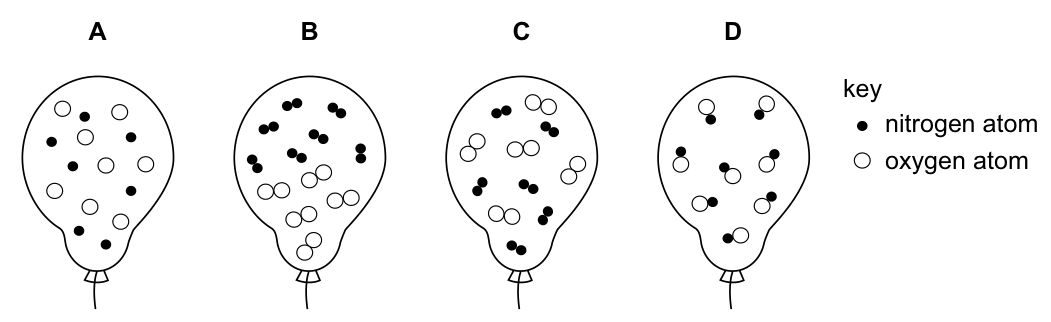 CorrectIncorrect
 -
-
Question 5 of 40
5. Question
The ion Q2+ has three complete shells of electrons.
What is Q?CorrectIncorrect -
Question 6 of 40
6. Question
The symbols for two ions are shown.

Which statement is correct?
CorrectIncorrect -
Question 7 of 40
7. Question
Two isotopes of chlorine are 35Cl and 37Cl.
Using these isotopes, how many different relative molecular masses are possible for the compound
with molecular formula C2H3Cl 3?CorrectIncorrect -
Question 8 of 40
8. Question
Ethane, C2H6, and ammonia, NH3, are covalent compounds.
The dot-and-cross diagrams of these compounds are shown.
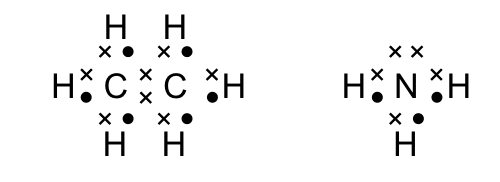 Which statements are correct?
1
A molecule of ethane contains twice as many hydrogen atoms as a molecule of ammonia.
2
An unreacted nitrogen atom has five outer electrons.
3
In a molecule of ethane, the bond between the carbon atoms is formed by sharing two
electrons, one from each carbon atom.CorrectIncorrect -
Question 9 of 40
9. Question
What happens to an atom of a Group II element when it forms a compound with oxygen?
CorrectIncorrect -
Question 10 of 40
10. Question
A compound contains 70% by mass of iron and 30% by mass of oxygen.
What is its empirical formula? [Ar: O, 16; Fe, 56]CorrectIncorrect -
Question 11 of 40
11. Question
The equation for the reaction between ethyne, C2H2, and oxygen is shown.
2C2H2(g) + xO2(g) → yCO2(g) + zH2O(g)
When the equation is balanced, what is x?CorrectIncorrect -
Question 12 of 40
12. Question
25.0 g of hydrated copper(II) sulfate crystals are heated to produce anhydrous copper(II) sulfate
and water.
CuSO4•5H2O(s) → CuSO4(s) + 5H2O(g)
What is the mass of anhydrous copper(II) sulfate formed?
[Mr: CuSO4, 160; H2O, 18]CorrectIncorrect -
Question 13 of 40
13. Question
The relative formula masses of four compounds are given.
A student has a 1.0 g sample of each compound.
Which sample contains the highest number of moles of oxygen atoms?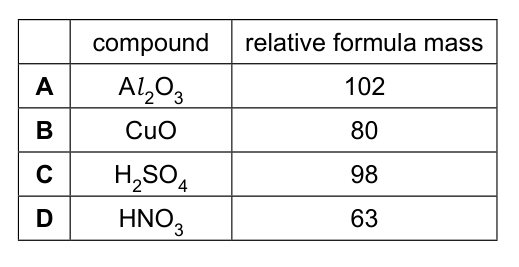 CorrectIncorrect
 -
-
Question 14 of 40
14. Question
50.0 cm3 of 0.10 mol / dm3 silver nitrate, AgNO3, is added to 150.0 cm3 of 0.05 mol / dm3
sodium iodide, NaI, in a beaker.
After the reaction, solid silver iodide is present in the beaker.
What else is present?CorrectIncorrect -
Question 15 of 40
15. Question
When 0.1 mol of the hydrocarbon, C5H12, is completely combusted it produces carbon dioxide,
CO2, and water, H2O.
C5H12(l) + 8O2(g) → 5CO2(g) + 6H2O(g)
What is the volume of carbon dioxide produced when measured at room temperature and
pressure?CorrectIncorrect -
Question 16 of 40
16. Question
Carbon electrodes are used to electrolyse aqueous copper(II) sulfate.
Which observations are made?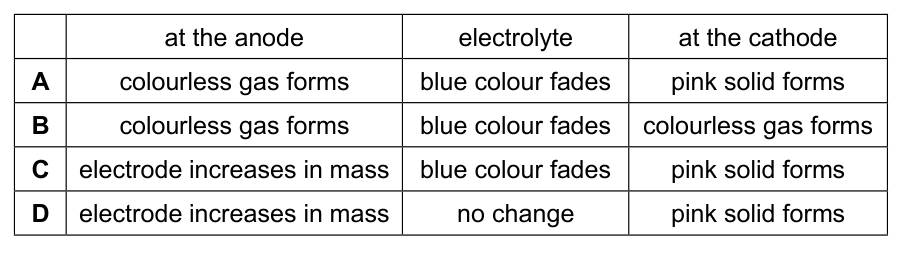 CorrectIncorrect
 -
-
Question 17 of 40
17. Question
Electrolysis is used to plate a metal coin with silver.
The coin is used as an electrode in a suitable electrolyte.
Which row is correct?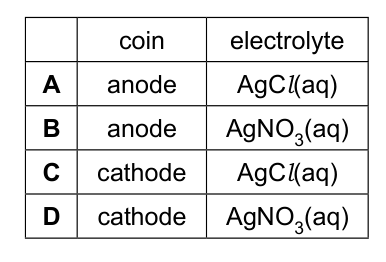 CorrectIncorrect
 -
-
Question 18 of 40
18. Question
An endothermic reaction has an activation energy of x.
Which reaction pathway diagram is correct for this reaction?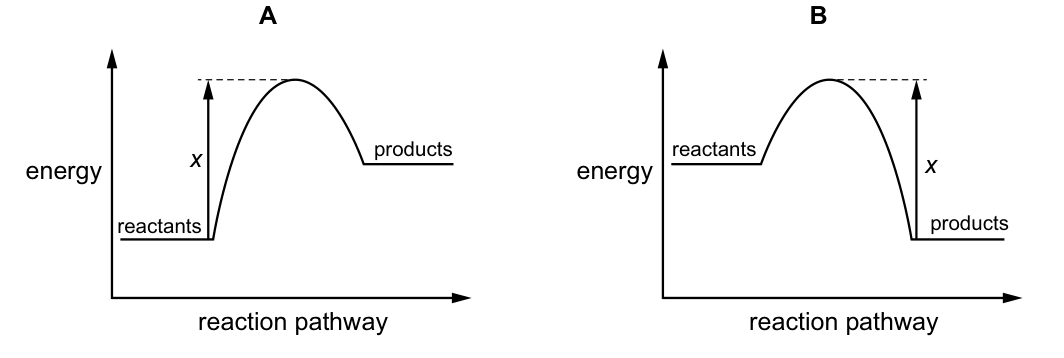
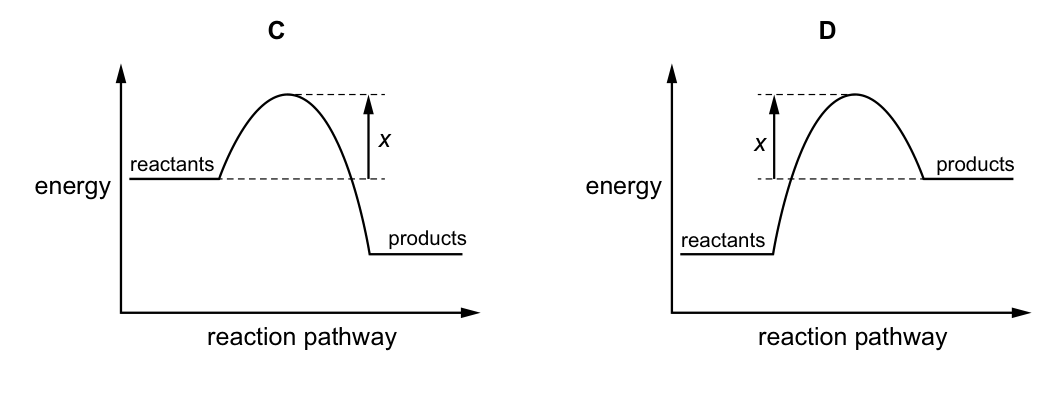 CorrectIncorrect
 -
-
Question 19 of 40
19. Question
The formation of liquid water from hydrogen and oxygen may occur in three stages.
1
2H2(g) + O2(g) → 4H(g) + 2O(g)
2
4H(g) + 2O(g) → 2H2O(g)
3
2H2O(g) → 2H2O(l)
Which stages are endothermic?CorrectIncorrect -
Question 20 of 40
20. Question
In four separate experiments, 1, 2, 3 and 4, nitric acid is added to an excess of marble pieces and
the volume of carbon dioxide gas formed is measured.
In all four experiments the same volume of nitric acid is used.
The concentration, or temperature, or both concentration and temperature of the nitric acid, are
changed.
The results of the experiments are shown on the graph.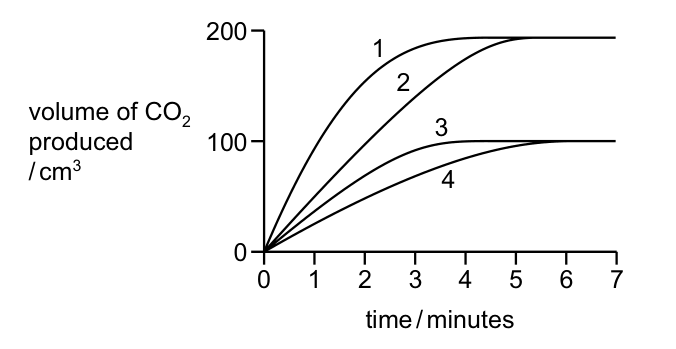
Which statement is correct?
CorrectIncorrect -
Question 21 of 40
21. Question
The equation shows the reaction for the manufacture of ammonia.
N2(g) + 3H2(g) ⇌ 2NH3(g)
Which change will decrease the activation energy of the reaction?CorrectIncorrect -
Question 22 of 40
22. Question
A reversible reaction is shown.
BiCl 3(aq) + H2O(l) ⇌ BiOCl (s) + 2HCl (aq)
Which changes increase the mass of the precipitate formed?
1
adding more water
2
adding aqueous sodium hydroxide
3
adding dilute hydrochloric acidCorrectIncorrect -
Question 23 of 40
23. Question
Sulfur trioxide is produced by the reversible reaction shown.
2SO2(g) + O2(g) ⇌ 2SO3(g) ∆H = −195 kJ / mol
Which change in conditions will produce a greater amount of SO3 at equilibrium?CorrectIncorrect -
Question 24 of 40
24. Question
Iron(II) ions react with chlorine.
2Fe2+(aq) + Cl 2(g) → 2Fe3+(aq) + 2Cl −(aq)
Which statement about this reaction is correct?CorrectIncorrect -
Question 25 of 40
25. Question
Which reactions involve oxidation and reduction?
1
chlorine gas reacting with aqueous potassium iodide
2
dilute sulfuric acid reacting with magnesium
3
dilute hydrochloric acid reacting with aqueous sodium hydroxideCorrectIncorrect -
Question 26 of 40
26. Question
Which statement about weak acids is correct?
CorrectIncorrect -
Question 27 of 40
27. Question
A colourless aqueous solution of pH 13 is tested separately with methyl orange indicator and
thymolphthalein indicator.
Which row is correct?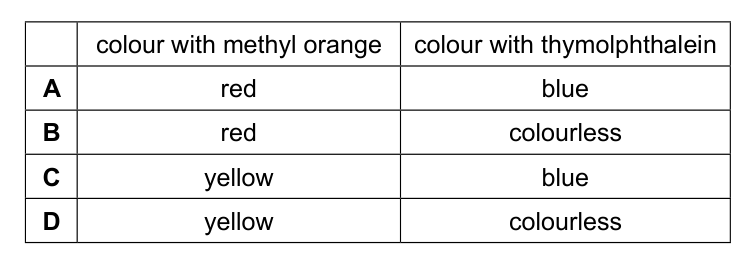 CorrectIncorrect
 -
-
Question 28 of 40
28. Question
Which pair of reagents is suitable for preparing a pure sample of copper(II) chloride crystals?
CorrectIncorrect -
Question 29 of 40
29. Question
Element X forms an oxide of formula X2O5.
In which group of the Periodic Table is X likely to be found?CorrectIncorrect -
Question 30 of 40
30. Question
The diagram shows the structure of an alloy.

Which statement about alloys is correct?
CorrectIncorrect -
Question 31 of 40
31. Question
Which compound has the lowest percentage by mass of nitrogen?
CorrectIncorrect -
Question 32 of 40
32. Question
The diagrams show the structures of five hydrocarbons.
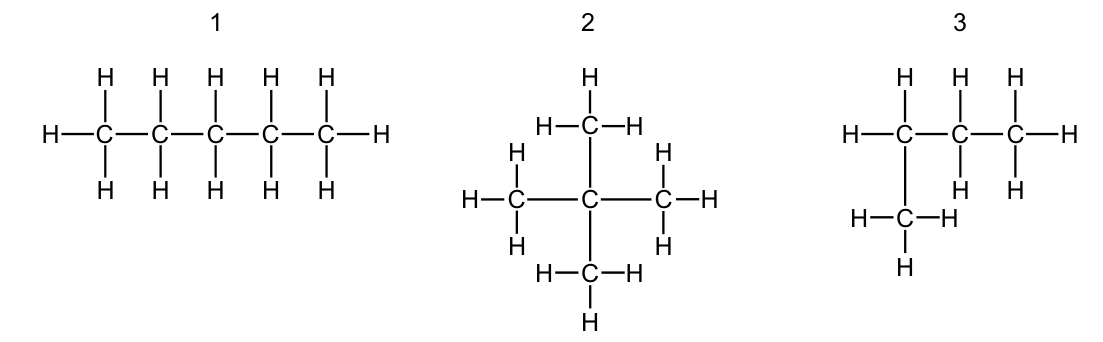
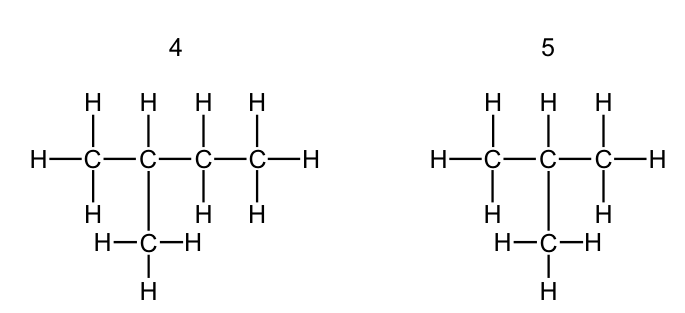
Which three hydrocarbons are isomers of each other?
CorrectIncorrect -
Question 33 of 40
33. Question
The diagram shows a fractionating column used in the separation of petroleum.
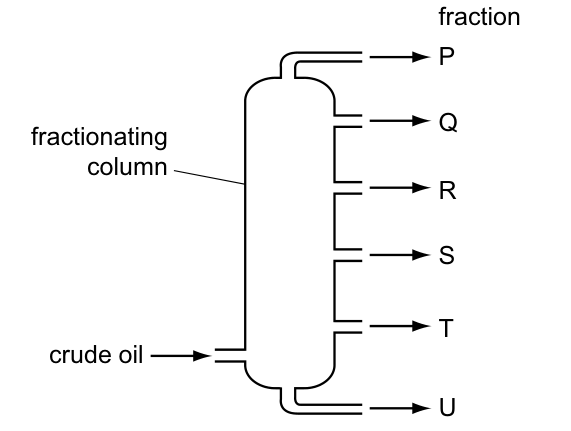
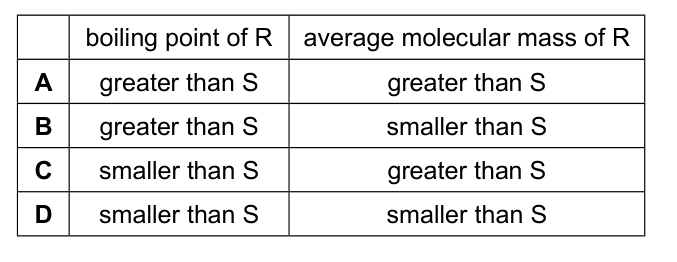
Which row explains why fraction R is collected above fraction S?
 CorrectIncorrect
 -
-
Question 34 of 40
34. Question
Which compound is an alkane?
 CorrectIncorrect
 -
-
Question 35 of 40
35. Question
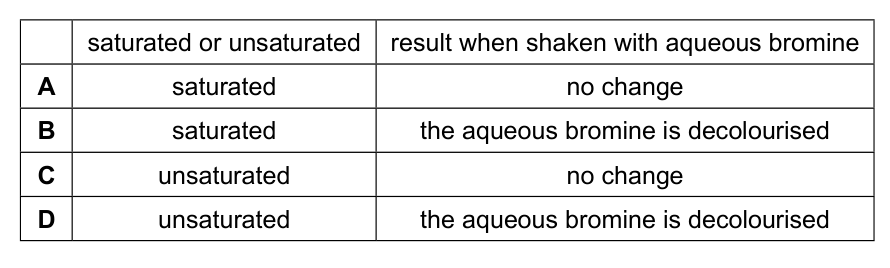
Which row correctly describes alkenes?
 CorrectIncorrect
 -
-
Question 36 of 40
36. Question
A carboxylic acid with molecular formula C4H8O2 reacts with an alcohol with molecular formula
C3H8O to form an ester.
What is the formula of the ester formed?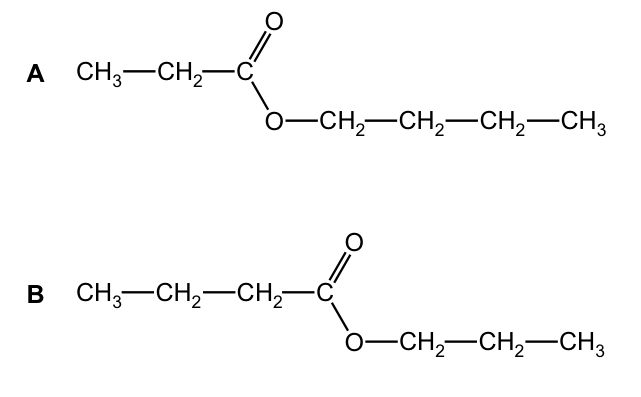
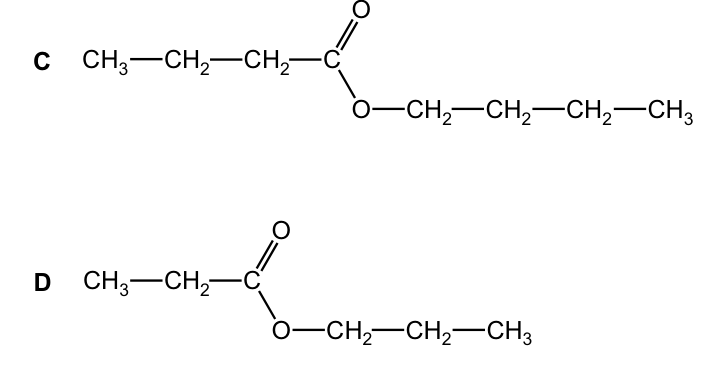 CorrectIncorrect
 -
-
Question 37 of 40
37. Question
The repeat unit of a polymer is shown.
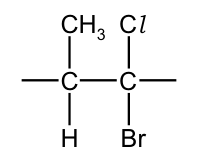
Which monomer would produce this polymer?
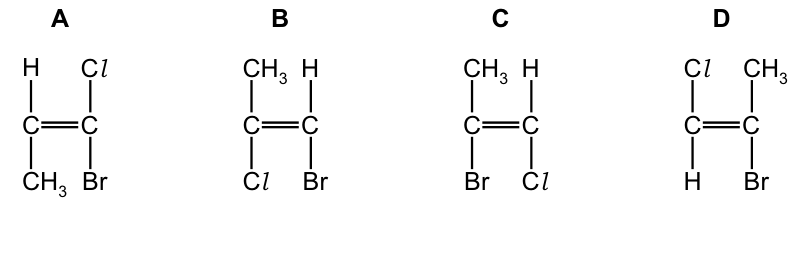 CorrectIncorrect
 -
-
Question 38 of 40
38. Question
When heated, magnesium reacts with oxygen in the air to form magnesium oxide, a white powder.
A student investigates the change in mass that occurs during this reaction. The student is given a
balance and the three sets of apparatus shown.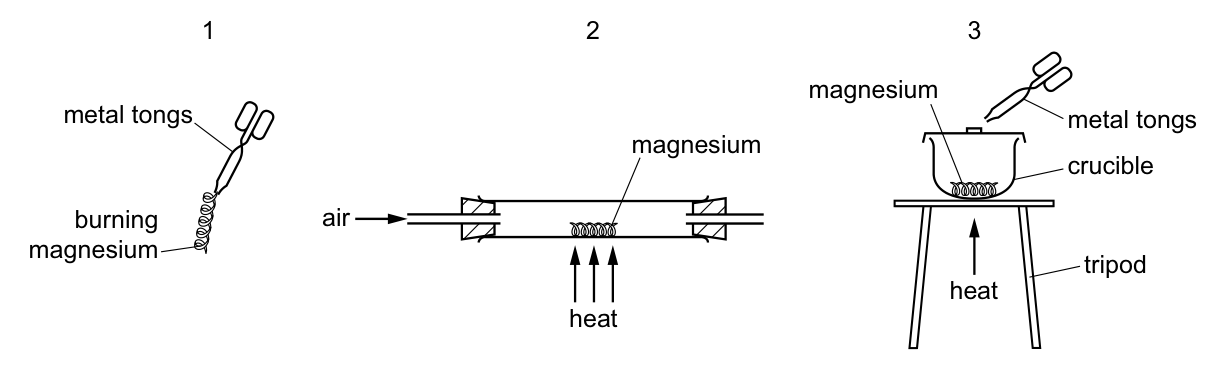
Which sets of apparatus are suitable for this investigation?
CorrectIncorrect -
Question 39 of 40
39. Question
A student uses paper chromatography to find an Rf value for Fe3+(aq). The result is shown.
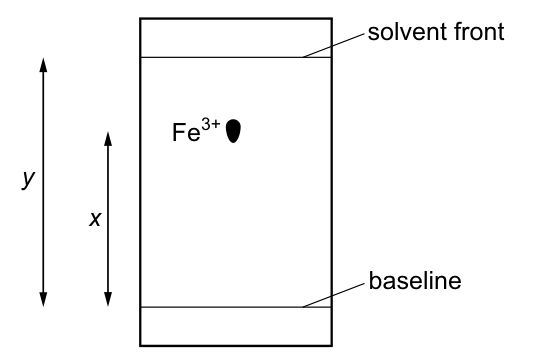
To make the spot containing Fe3+(aq) more visible, the paper is sprayed with aqueous
sodium hydroxide so that a precipitate of iron(III) hydroxide forms.
Under the conditions of the experiment, the Rf value of Fe3+(aq) is given by …..1….. and the
colour of the precipitate is …..2….. .
Which row correctly completes gaps 1 and 2?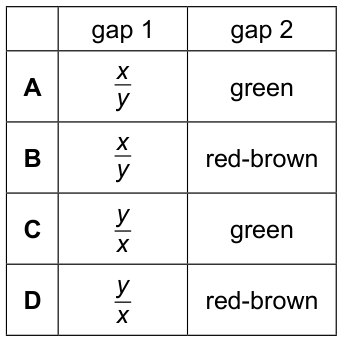 CorrectIncorrect
 -
-
Question 40 of 40
40. Question
Tests on an aqueous solution of an unknown compound P are shown in the table.
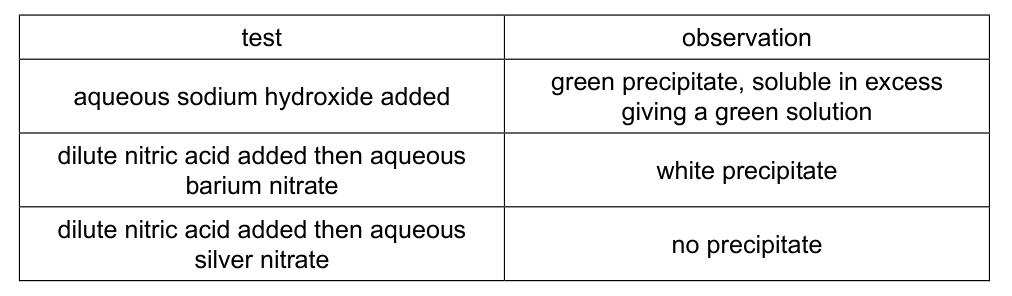
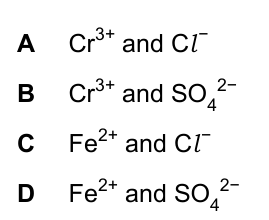
Which ions are present in P?
 CorrectIncorrect
 -
