
Duration: 1:30 minutes
Instructions:
Answer all the questions in this paper
Write your final answers in the spaces provided

Quiz Summary
0 of 7 Questions completed
Questions:
Information
You have already completed the quiz before. Hence you can not start it again.
Quiz is loading…
You must sign in or sign up to start the quiz.
You must first complete the following:
Results
Results
0 of 7 Questions answered correctly
Your time:
Time has elapsed
You have reached 0 of 0 point(s), (0)
Earned Point(s): 0 of 0, (0)
0 Essay(s) Pending (Possible Point(s): 0)
| Average score |
|
| Your score |
|
Categories
- Not categorized 0%
- 1
- 2
- 3
- 4
- 5
- 6
- 7
- Current
- Review
- Answered
- Correct
- Incorrect
-
Question 1 of 7
1. Question
(a) The points A and B have coordinates (–2, 15) and (3, 5) respectively. The perpendicular
to the line AB at the point A (–2, 15) crosses the y-axis at the point C. Find the coordinates of C [4]
(b) The line x – y = 2 intersects the curve x2 + 4xy = 4 at the points A and B. Find the coordinates of A and of B [5]
A (has the smallest value of x)
-
(i) C = ( , )
(ii) A = ( , ) B = ( , )
Correct 8 / 8 PointsIncorrect / 8 Points -
-
Question 2 of 7
2. Question
Solve the simultaneous equation
2x + y – 3z = – 2
3x + y + 2z = 1
x – 2y – 4z = – 16
-
x = , y = , z =
Correct 6 / 6 PointsIncorrect / 6 Points -
-
Question 3 of 7
3. Question
A function is defined by f:x→(3x-1)/2 . Find
(i) The value of a given that ff(a)=5/8 [3]
(ii) The value of x such that f -I(x)=f(x) [3]
-
(i) a =
(ii) x =
Correct 6 / 6 PointsIncorrect / 6 Points -
-
Question 4 of 7
4. Question
(a) Express 2 – 3x – x2 in the form q + a(x + p)2 where a, p and q are constants. Hence, find the values of a, p and q, the
coordinates of the turning point and stating whether it is maximum or minimum [6]
(b) Find the range of values of k for which the equation x2 – 4x – 10 = k has real roots. [3]
-
(i) a = , p = , q =
the T.P = ( , )
(ii) the range is
Correct 6 / 6 PointsIncorrect / 6 Points -
-
Question 5 of 7
5. Question
(a) The sixth term of an arithmetic progression is – 7 and the sum of the first 10 terms is – 60. Calculate;
(i) The first term and the common difference [3]
(ii)The 20th term [2]
(b) Given that the 2nd and 5th term of a geometric progression are 10 and 5/4 Find
(i) The first term and the common ratio [4]
(ii) The sum of the first six terms [3]
(iii) The sum to infinity of this geometric progression [2]
-
(a) (i) a = , d =
(ii) The 20th term =
(b) (i) The first term (a) = , the common ratio (r) =
(ii) The sum of the first six terms =
(iii) The sum to infinity =
Correct 16 / 16 PointsIncorrect / 16 Points -
-
Question 6 of 7
6. Question
(a) The first three terms in the expansion of (1 + ax)n in ascending powers of x are 1 – 12x + 63x2.
Find the values of a and n. [5]
(b) Find the term independent of x in the expansion of (2x3 + 1/x)n [4]
-
(i) a= , n =
(ii) answer =
Correct 10 / 10 PointsIncorrect / 10 Points -
-
Question 7 of 7
7. Question
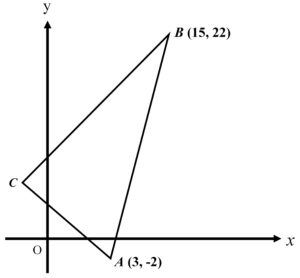
The diagram shows a triangle ABC in which A is (3, -2) and B is (15,22). The gradients of AB, AC and BC are 2m, -2m and m respectively, where m is a positive constant.
(i) Find the gradient of AB and deduce the value of m [2]
(ii) Find the coordinates of C [4]
The perpendicular bisector of AB meets BC at D
(iii) Find the coordinates of D [4]
-
(i) m =
(ii) The coordinate of C= ( , )
(ii) D = ( , )
Correct 10 / 10 PointsIncorrect / 10 Points -
