
DURATION : 1 HOUR
INSTRUCTIONS TO CANDIDATES
– Answer all the question in this paper
– For multiple choice questions choose the correct answer
– for non multiple choice questions write the FINAL answer in the space provide

Quiz Summary
0 of 13 Questions completed
Questions:
Information
You have already completed the quiz before. Hence you can not start it again.
Quiz is loading…
You must sign in or sign up to start the quiz.
You must first complete the following:
Results
Results
0 of 13 Questions answered correctly
Your time:
Time has elapsed
You have reached 0 of 0 point(s), (0)
Earned Point(s): 0 of 0, (0)
0 Essay(s) Pending (Possible Point(s): 0)
Categories
- Not categorized 0%
- 1
- 2
- 3
- 4
- 5
- 6
- 7
- 8
- 9
- 10
- 11
- 12
- 13
- Current
- Review
- Answered
- Correct
- Incorrect
-
Question 1 of 13
1. Question
The diagram shows one method of measuring the diameter of a beaker.
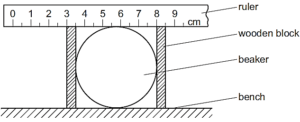
What is the diameter of the beaker?
CorrectIncorrect -
Question 2 of 13
2. Question
The width of a wooden block is measured using Vernier calipers.
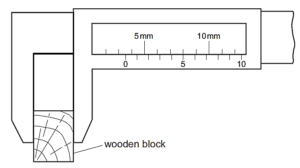
What is the width of the block?
CorrectIncorrect -
Question 3 of 13
3. Question
What must change when a body is accelerating?
CorrectIncorrect -
Question 4 of 13
4. Question
A lump of metal has a mass of 210 g. It is lowered into a measuring cylinder containing water. The level of the water rises from 35 cm3 to 140 cm3.
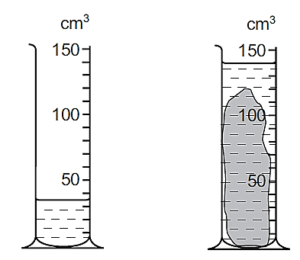
What is the density of the metal?
CorrectIncorrect -
Question 5 of 13
5. Question
A body of mass 10 kg falling freely in the gravitational field close to the Moon’s surface has an acceleration of 1.6 m/s2.
What is the gravitational field strength on the Moon?
CorrectIncorrect -
Question 6 of 13
6. Question
The diagram shows a strip of paper tape that has been pulled under a vibrating arm by an object moving at constant speed. The arm was vibrating regularly, making 50 dots per second.

What was the speed of the object?
CorrectIncorrect -
Question 7 of 13
7. Question
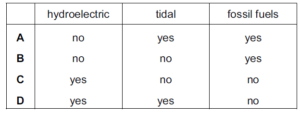
Hydroelectric, tidal and fossil fuels are three sources of energy.
Which of renewable energy sources? these are
 CorrectIncorrect
 -
Question 8 of 13
8. Question
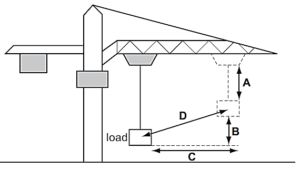
A crane moves its load diagonally, as shown in the diagram below. By what distance is the weight of the load multiplied in order to calculate the increase in gravitational potential energy of the load?
 CorrectIncorrect
 -
Question 9 of 13
9. Question
A 2 kg mass is moving at constant speed. The kinetic energy of the mass is 400 J. What is the speed of the mass?
CorrectIncorrect -
Question 10 of 13
10. Question
The diagram below shows a vernier calliper used to measure a physical quantity
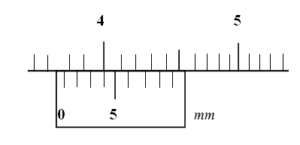
- What is the reading on the vernier calliper?
Main scale reading = ________
Vernier Scale reading = ___________
Total = __________
- What physical quantity does the vernier calliper measure?
-
Main scale reading = mm
Vernier Scale reading = mm
Total = mm
What physical quantity does the vernier calliper measure?
Correct 4 / 4 PointsIncorrect / 4 Points -
Question 11 of 13
11. Question
The Figure below shows a car travelling at 30 m/s on a level road. At this speed the car has to overcome a total force of 600 N opposing the car.

(i) Calculate the distance travelled by the car in 10 s
(ii) State the value of the driving force produced by the engine for a steady speed of 30 m/s
(iii) While on the level road and travelling at 30 m/s, the driving force becomes zero. The mass of the car is 800 kg. Calculate the deceleration of the car.
-
Distance = m
Force = N
Deceleration = m/s square
Correct 6 / 6 PointsIncorrect / 6 Points -
-
Question 12 of 13
12. Question
A cube has sides that are 3.0 cm long. The mass of the cube is 54 g.
(a) Calculate the density of the cube.
(b) Calculate the weight of the cube.
-
Density = g/cm3
Weight = N
Correct 4 / 4 PointsIncorrect / 4 Points -
-
Question 13 of 13
13. Question
The figure below shows a device for punching holes in a piece of paper. A person applies a force F at the end of the arm. Just before the hole is made in the paper, the arm is at rest.
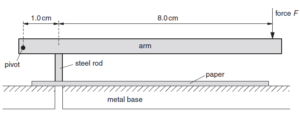
Just before the hole is made, the force upwards on the steel rod is 7.2 N. Calculate the value of F. Use the distances marked on Figure above.
-
Force = N
CorrectIncorrect -
