

Quiz Summary
0 of 7 Questions completed
Questions:
Information
You have already completed the quiz before. Hence you can not start it again.
Quiz is loading…
You must sign in or sign up to start the quiz.
You must first complete the following:
Results
Results
0 of 7 Questions answered correctly
Your time:
Time has elapsed
You have reached 0 of 0 point(s), (0)
Earned Point(s): 0 of 0, (0)
0 Essay(s) Pending (Possible Point(s): 0)
| Average score |
|
| Your score |
|
Categories
- Not categorized 0%
- 1
- 2
- 3
- 4
- 5
- 6
- 7
- Current
- Review
- Answered
- Correct
- Incorrect
-
Question 1 of 7
1. Question
THe diagram below shows the directions of four forces acting on a racing car as it travels in a horizontal straight line.
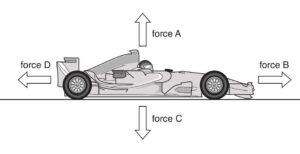
Drag the answers in the corresponding box.
Sort elements
- contact or reaction force
- driving force
- force of gravity
- air resistance and friction
-
Force A
-
Force B
-
Force C
-
Force D
CorrectIncorrect -
Question 2 of 7
2. Question
(a) The table shows the sizes of the forces acting on the car (in “1” ) at one time.

The gravitational field strength g is 10 N / kg.
Calculate
(i) the mass of the car, [1](ii) the resultant force on the car, [1]
(iii) the acceleration of the car. [2]
(b) At another time, the car is travelling at speed u. It then accelerates for 5.0 s with an acceleration
of 1.6 m / s2, and reaches a speed of 20 m / s. Calculate the value of u. [2]-
(i) mass = Kg
(ii) Resultant force = N
(iii) Accerelation = m/s/s
(b) u = m/s
Correct 6 / 6 PointsIncorrect / 6 Points -
-
Question 3 of 7
3. Question
The figure below shows an arrangement of three resistors.
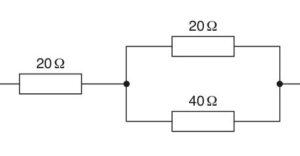
Calculate the total resistance of this arrangement.
-
Total resistance = ohms
Correct 3 / 3 PointsIncorrect / 3 Points -
-
Question 4 of 7
4. Question
The diagram below shows a 240 V a.c. mains supply connected to a television and two lamps.
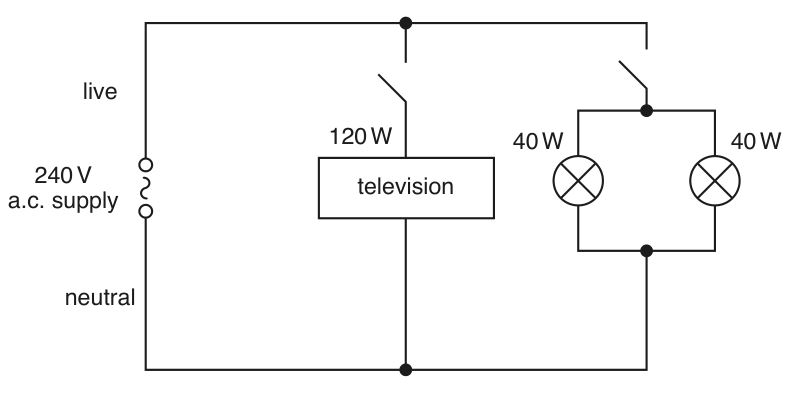
In normal operation, the power supplied to each lamp is 40 W and the power supplied to the
television is 120 W.
Calculate, in normal operation,
(i) the total power supplied, [2](ii) the total number of kilowatt-hours (kW h) of energy supplied to the circuit in 3.0 hours, [2]
(iii) the current in each lamp. [2]
-
(i) power = W
(ii) number of kW h =
(iii) Current =
Correct 6 / 6 PointsIncorrect / 6 Points -
-
Question 5 of 7
5. Question
Different energy sources are used to generate electricity. Below is a block diagram of a power station that produces electrical energy from oil.
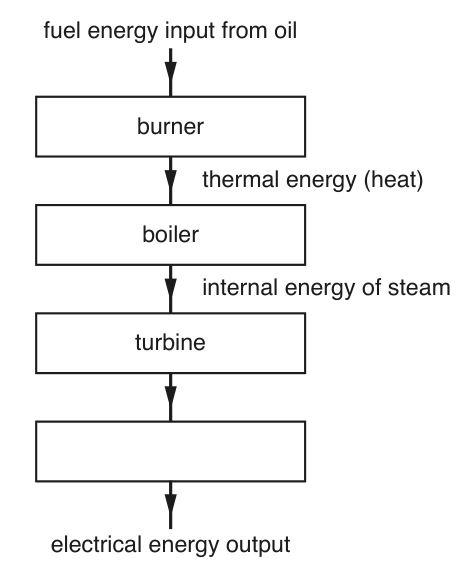
(i) Write the name of the missing part of the power station in the empty box [1]
(ii) State the form of energy that the turbine possesses. [1]
(ii) A small boiler in the power station contains 24 m3 of water at 30 °C. High pressure in the
boiler increases the boiling point of water to 120 °C.
Thermal energy supplied to the boiler is used to heat the water from 30 °C to 120 °C and
then to turn it all to steam at 120 °C.
The density of water is 1000 kg / m3.
The specific heat capacity of water is 4200 J / (kg °C).
The specific latent heat of vaporisation of water is 2.3 × 10⁶ J / kg.1. Calculate the mass of water in the boiler. [1]
2. Calculate the total thermal energy (heat) supplied to the boiler. [4]
-
(i)
(ii) energy
(iii)
1. mass = Kg
2. Total thermal energy = x 1010 J
Correct 7 / 7 PointsIncorrect / 7 Points -
-
Question 6 of 7
6. Question
A loudspeaker produces a sound of frequency 2.0 kHz. The wavelength of this sound in air is 16 cm.
(i) Calculate the speed of sound in air. [2](ii) State the range of frequencies that can be heard by a healthy human ear. [2]
(iii) Calculate the smallest wavelength of sound that can be heard by a healthy human ear. [1]
-
(i) Speed = m/s
(ii) Hz to kHz
(iii) cm
Correct 5 / 5 PointsIncorrect / 5 Points -
-
Question 7 of 7
7. Question
The student places the thermistor in a water bath at various temperatures and records the
reading on the ammeter.
The figure below shows how the current varies with temperature.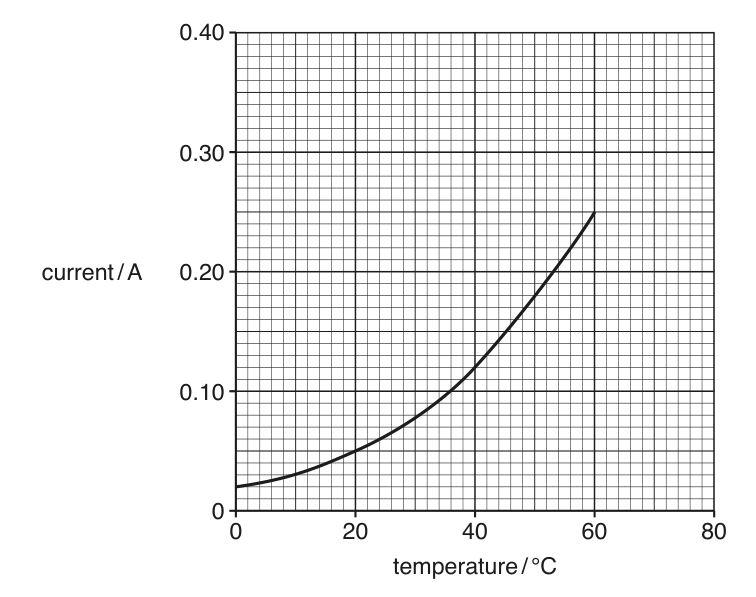
The potential difference (p.d.) across the thermistor remains constant.
The resistance of the thermistor is 240 Ω at a temperature of 20 °C.
Using the figure, calculate
1. the potential difference (p.d.) across the thermistor, [3]2. the resistance of the thermistor at a temperature of 40 °C. [2]
-
- P.d = V
- Resistance = Ohms
Correct 5 / 5 PointsIncorrect / 5 Points -
