

Quiz Summary
0 of 6 Questions completed
Questions:
Information
You have already completed the quiz before. Hence you can not start it again.
Quiz is loading…
You must sign in or sign up to start the quiz.
You must first complete the following:
Results
Results
0 of 6 Questions answered correctly
Your time:
Time has elapsed
You have reached 0 of 0 point(s), (0)
Earned Point(s): 0 of 0, (0)
0 Essay(s) Pending (Possible Point(s): 0)
| Average score |
|
| Your score |
|
Categories
- Not categorized 0%
- 1
- 2
- 3
- 4
- 5
- 6
- Current
- Review
- Answered
- Correct
- Incorrect
-
Question 1 of 6
1. Question
In an experiment, a student takes measurements and determines the extension of a spring for
different loads. The apparatus is shown in the diagram below.
The table below shows the results.

(a) What are the values of x and y? [2]
(b) Calculate the load that produces an extension of 49 mm. [2]
-
(a) x = y =
(b) load = N
Correct 4 / 4 PointsIncorrect / 4 Points -
-
Question 2 of 6
2. Question
The metal has a mass of 5.0 kg and a density of 7.5 × 10³ kg / m3.
Calculate the volume of the metal.
Give your answer to a suitable number of significant figures. [3]-
Volume = x 10-4 cubic meter
Correct 3 / 3 PointsIncorrect / 3 Points -
-
Question 3 of 6
3. Question
The diagram shows one method of measuring the thermal energy needed to melt ice. The ice is
contained in a glass funnel and covered with an insulator.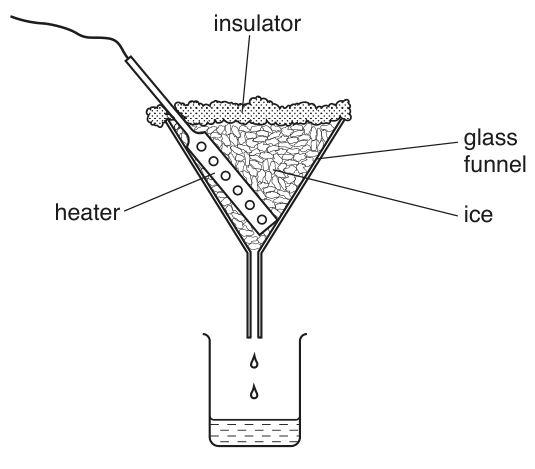
The heater is switched on and the ice melts.
The specific latent heat of fusion of ice is 3.3 × 10⁵ J / kg.
Calculate the energy needed to melt 5.0 g of ice. [3]-
Energy = J
Correct 3 / 3 PointsIncorrect / 3 Points -
-
Question 4 of 6
4. Question
A microwave signal from a transmitter on the Earth’s surface is sent up to a satellite in orbit and is
then immediately transmitted back to Earth.A pulse of microwaves from the transmitter is received back at the transmitter 0.24 s later.
The speed of microwaves is 3.0 × 10⁸ m / s.
Calculate the distance from the transmitter on the Earth to the satellite. [3]-
distance = x 107 m
Correct 3 / 3 PointsIncorrect / 3 Points -
-
Question 5 of 6
5. Question
Wind energy is a renewable energy source. A wind turbine and generator convert energy in the
wind to electrical energy in a generator. The figure below shows some wind turbines.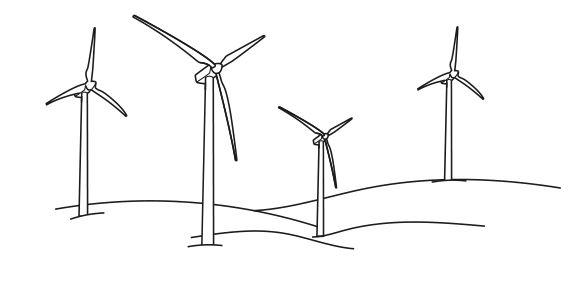
During a 30 minute period, a mass of 4.2 × 10⁷ kg of air enters the turbine with a speed of 15 m / s.
(i) Calculate the kinetic energy of the air that enters the turbine in 30 minutes. [2]
(ii) The electrical power output of the generator connected to the turbine is 8.4 × 10⁵ W. Calculate the electrical energy output from the turbine in 30 minutes. [2]
(iii) Calculate the efficiency of the turbine and generator in converting the kinetic energy of
the air to electrical energy. [2]-
(i) Kinetic energy = 109 J
(ii) Energy output = 109 J
(iii) Efficiency = %
Correct 6 / 6 PointsIncorrect / 6 Points -
-
Question 6 of 6
6. Question
A student connects a battery to two resistors. The circuit diagram is shown below
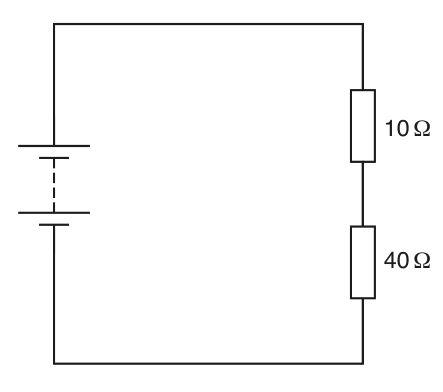
The potential difference (p.d.) across the 40 Ω resistor is 9.6 V.
(i) Calculate the current in the 40 Ω resistor. [2]
(ii) Calculate the electromotive force (e.m.f.) of the battery. [2]
(iii) Calculate the power P produced in the 10 Ω resistor. [2]
-
(i) Current = A
(ii) e.m.f = v
(iii) P = W
Correct 6 / 6 PointsIncorrect / 6 Points -
